

List of Presidents of India (1950–2026): Complete Guide with Tenure & Facts

The President of India is the constitutional head of state, the first citizen of the country, and the Supreme Commander of the Indian Armed Forces. While real executive power rests with the Prime Minister and Council of Ministers, every major governmental action in India — from assenting to laws to appointing judges — is formally carried out in the President's name.
Since the Constitution took effect on 26 January 1950, India has been led by 15 full-term Presidents. This list of Indian Presidents is one of the most frequently asked topics in UPSC, SSC, banking, railway, and state PSC exams, largely because it blends constitutional knowledge with modern Indian history in a way few other topics do.
Below is the complete, chronological Indian president list — from Dr. Rajendra Prasad to the current President, Droupadi Murmu.
Full List of Presidents of India with Tenure
The complete List of Presidents of India with their tenure periods is in the table below
|
No. |
President |
Term Start |
Term End |
Party at Election |
|
1 |
Dr. Rajendra Prasad |
26 Jan 1950 |
13 May 1962 |
Indian National Congress |
|
2 |
Dr. Sarvepalli Radhakrishnan |
13 May 1962 |
13 May 1967 |
Independent |
|
3 |
Dr. Zakir Husain † |
13 May 1967 |
3 May 1969 |
Independent |
|
— |
V. V. Giri (Acting) |
3 May 1969 |
20 Jul 1969 |
— |
|
— |
Mohammad Hidayatullah (Acting) |
20 Jul 1969 |
24 Aug 1969 |
— |
|
4 |
V. V. Giri |
24 Aug 1969 |
24 Aug 1974 |
Independent |
|
5 |
Fakhruddin Ali Ahmed † |
24 Aug 1974 |
11 Feb 1977 |
Indian National Congress |
|
— |
B. D. Jatti (Acting) |
11 Feb 1977 |
25 Jul 1977 |
— |
|
6 |
Neelam Sanjiva Reddy |
25 Jul 1977 |
25 Jul 1982 |
Janata Party |
|
7 |
Giani Zail Singh |
25 Jul 1982 |
25 Jul 1987 |
Indian National Congress |
|
8 |
Ramaswamy Venkataraman |
25 Jul 1987 |
25 Jul 1992 |
Indian National Congress |
|
9 |
Dr. Shankar Dayal Sharma |
25 Jul 1992 |
25 Jul 1997 |
Indian National Congress |
|
10 |
K. R. Narayanan |
25 Jul 1997 |
25 Jul 2002 |
Independent |
|
11 |
Dr. A. P. J. Abdul Kalam |
25 Jul 2002 |
25 Jul 2007 |
Independent |
|
12 |
Pratibha Patil |
25 Jul 2007 |
25 Jul 2012 |
Indian National Congress |
|
13 |
Pranab Mukherjee |
25 Jul 2012 |
25 Jul 2017 |
Indian National Congress |
|
14 |
Ram Nath Kovind |
25 Jul 2017 |
25 Jul 2022 |
Bharatiya Janata Party |
|
15 |
Droupadi Murmu |
25 Jul 2022 |
Incumbent |
BharatiyaJanata Party |
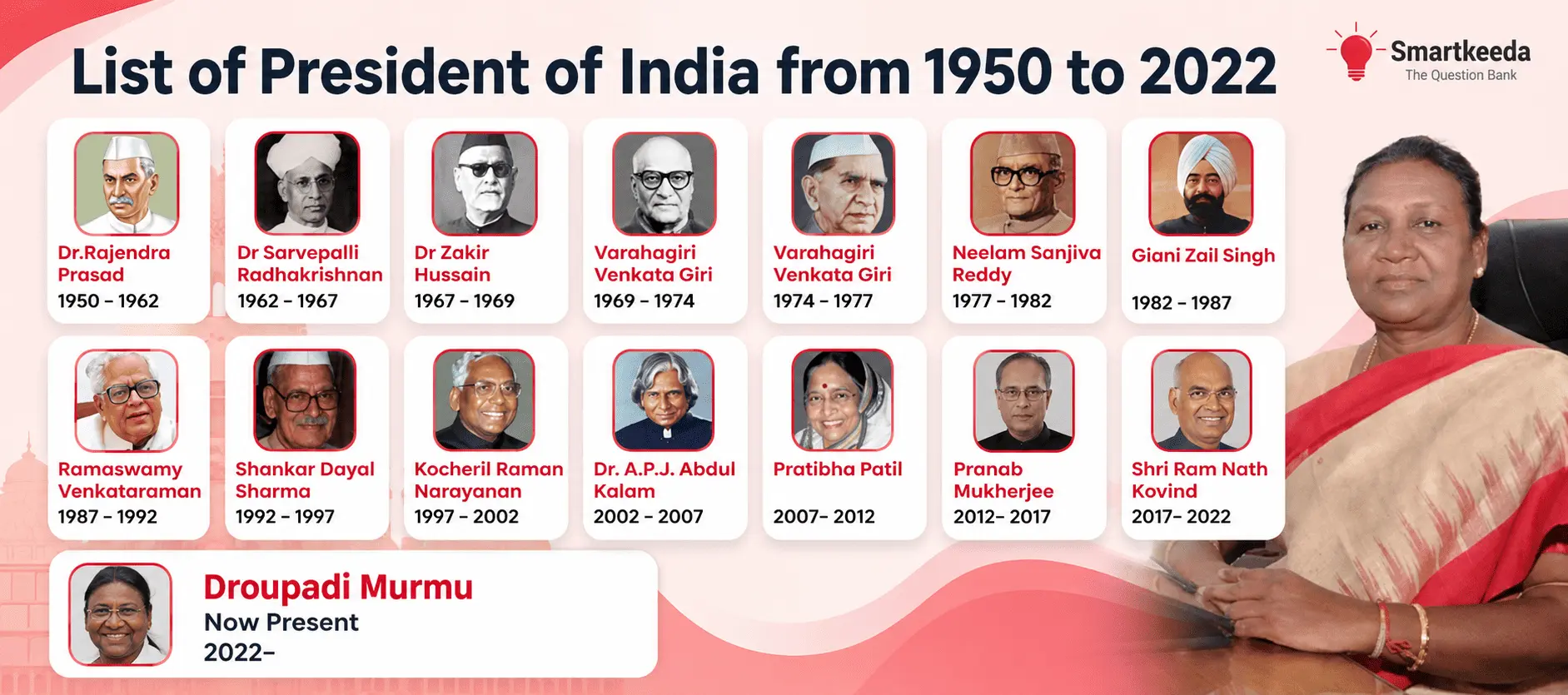
Profile of Every President of India
A closer look at each President's tenure, background, and key contributions to the office.1. Dr. Rajendra Prasad (1950–1962)
India's first President and the only one to serve two full terms. A veteran of the freedom movement and former president of the Constituent Assembly, he set the tone for a restrained, dignified presidency. He received the Bharat Ratna in 1962.
2. Dr. Sarvepalli Radhakrishnan (1962–1967)
A globally respected philosopher and academic, Radhakrishnan had earlier served as Vice President. His birthday, 5 September, is observed as Teacher's Day across India in recognition of his lifelong commitment to education.
3. Dr. Zakir Husain (1967–1969)
The first President from a religious minority and a noted educationist who co-founded Jamia Millia Islamia. He died in office in 1969, triggering India's first transition through an Acting President.
4. V. V. Giri (1969, Acting; 1969–1974, elected)
Giri is unique in Indian history: he served first as Acting President after Husain's death, then won the subsequent election in his own right as an independent candidate — the only person to hold both roles.
5. Mohammad Hidayatullah (1969, Acting)
The sitting Chief Justice of India, Hidayatullah briefly served as Acting President for about five weeks in 1969 while Giri campaigned for the presidency himself.
6. Fakhruddin Ali Ahmed (1974–1977)
The second President to die in office. His tenure coincided with major political turbulence, including the imposition of the Emergency in 1975.
7. B. D. Jatti (1977, Acting)
As Vice President, Jatti stepped in as Acting President following Ahmed's death, holding the post for about five months until a new President was elected.
8. Neelam Sanjiva Reddy (1977–1982)
The only President to be elected unopposed. He moved directly from the Speakership of the Lok Sabha to the presidency, a rare career path in Indian politics.
9. Giani Zail Singh (1982–1987)
India's first Sikh President, whose term saw two of the most consequential events in modern Indian history: Operation Blue Star and the assassination of Prime Minister Indira Gandhi.
10. Ramaswamy Venkataraman (1987–1992)
A former Defence Minister and freedom fighter, Venkataraman guided the presidency through a period of shifting coalition politics with a reputation for constitutional caution.
11. Dr. Shankar Dayal Sharma (1992–1997)
Known for taking his oath of office in Hindi, Sharma navigated two hung Parliaments during his term, reinforcing the President's discretionary role in government formation.
12. K. R. Narayanan (1997–2002)
India's first President from the Dalit community, Narayanan was known for actively using his discretionary powers — notably asking a government to prove its majority rather than acting purely on ceremony.
13. Dr. A. P. J. Abdul Kalam (2002–2007)
Widely called the "People's President" and the "Missile Man of India," Kalam was the first scientist to hold the office. His accessibility and focus on youth and innovation made him one of India's most popular Presidents.
14. Pratibha Patil (2007–2012)
India's first woman President, Patil's election in 2007 marked a historic milestone for gender representation in the country's highest constitutional office.
15. Pranab Mukherjee (2012–2017)
A veteran of Indian politics with decades of experience across finance, defence, and external affairs portfolios, Mukherjee brought deep institutional knowledge to the presidency.
16. Ram Nath Kovind (2017–2022)
A lawyer and former Governor of Bihar, Kovind's presidency emphasised social justice and outreach to marginalised communities.
17. Droupadi Murmu (2022–present)
India's 15th and current President, Murmu is the first person from a tribal community and only the second woman to hold the office. A former Governor of Jharkhand and schoolteacher from Odisha, she took oath on 25 July 2022.
Acting Presidents of India — Often Missed in Exams
A common exam trap is assuming India has had exactly 15 people occupy Rashtrapati Bhavan. In fact, three individuals served as Acting President without ever being elected to a full term:
- V. V. Giri (1969) — later won election in his own right
- Mohammad Hidayatullah (1969) — Chief Justice of India at the time
- B. D. Jatti (1977) — serving Vice President at the time
These acting terms are not included in the official numbering of Presidents, which is why India is described as having had "15 Presidents," not 18.
Pactice General knowledge Quizzes
How the President of India Is Elected
The President is not directly elected by citizens. Instead, election happens through an Electoral College consisting of:
- Elected members of the Lok Sabha and Rajya Sabha
- Elected members of the Legislative Assemblies of states, plus Delhi and Puducherry
Voting uses a single transferable vote system with a proportional representation formula, and each vote is weighted according to the population and number of seats in that constituency — a design meant to give every state a fair share of influence, regardless of its size.
The President serves a five-year term under Article 56 and may seek re-election any number of times, though in practice most Presidents serve a single term.
Eligibility to Become President of India
Under Article 58, a candidate must:
- Be a citizen of India
- Be at least 35 years old
- Be qualified to be elected as a member of the Lok Sabha
- Not hold any office of profit under the central government, state governments, or local authorities (certain constitutional posts are exempt)
Powers and Role of the President
Although the role is largely ceremonial, the President's constitutional powers are significant:
-
Executive: All government action is formally taken in the President's name (Article 53)
-
Legislative: Summons and prorogues Parliament, gives assent to bills, and can issue ordinances when Parliament isn't in session
-
Judicial: Appoints the Chief Justice and other judges, and holds the power to grant pardons (Article 72)
-
Emergency Powers: Can proclaim National, State, or Financial Emergency under Articles 352, 356, and 360
-
Military: Serves as Supreme Commander of the Armed Forces
The President can be removed only through impeachment for "violation of the Constitution" under Article 61 — a process that has never been completed against any Indian President.
Constitution of India Quizzes
Key Facts and Firsts Every Aspirant Should Know
|
Distinction |
President |
|
First President of India |
Dr. Rajendra Prasad |
|
Only President to serve two full terms |
Dr. Rajendra Prasad |
|
First woman President |
Pratibha Patil |
|
First Dalit President |
K. R. Narayanan |
|
First Sikh President |
Giani Zail Singh |
|
First Muslim President |
Dr. Zakir Husain |
|
First scientist-President |
Dr. A. P. J. Abdul Kalam |
|
First tribal President |
Droupadi Murmu |
|
Only President elected unopposed |
Neelam Sanjiva Reddy |
|
Only President also elected as Acting President |
V. V. Giri |
|
Presidents who died in office |
Dr. Zakir Husain, Fakhruddin Ali Ahmed |
|
Current President |
Droupadi Murmu |

SBI PO Mains 2026 GA Analysis (12 Sep)
SBI PO Mains 2026 GA Analysis (12th September 2026): 75% Questions Directly Covered from CA MockDrill
14 Sep 2026

IBPS PO Prince Success Story
From Reserve List to IBPS PO Selection: Prince's Journey with Smartkeeda
5 Sep 2026

Prerna Mahor Success story
How Prerna Mahour Cracked SBI Clerk & IBPS Clerk Together with Private Job
20 Jul 2026

Women Freedom Fighters of India
15 Women Freedom Fighters of India: The Untold Stories of Courage (1780–1947)
18 Jul 2026