

15 Women Freedom Fighters of India: The Untold Stories of Courage (1780–1947)

When people talk about India's freedom struggle, the same handful of names tend to repeat — yet the fight against colonial rule was carried just as fiercely by women, from queens who led armies to teenage students who broadcast banned radio messages. This article brings together 15 women freedom fighters of India, spanning nearly 170 years of resistance, including several lesser-known figures who rarely make it into standard lists.
Unlike most roundups that stop at the same 8-10 familiar names, this guide also covers Dalit warriors, tribal and regional icons, and the youngest martyrs of the movement — giving you a fuller, more accurate picture of how women shaped India's independence.
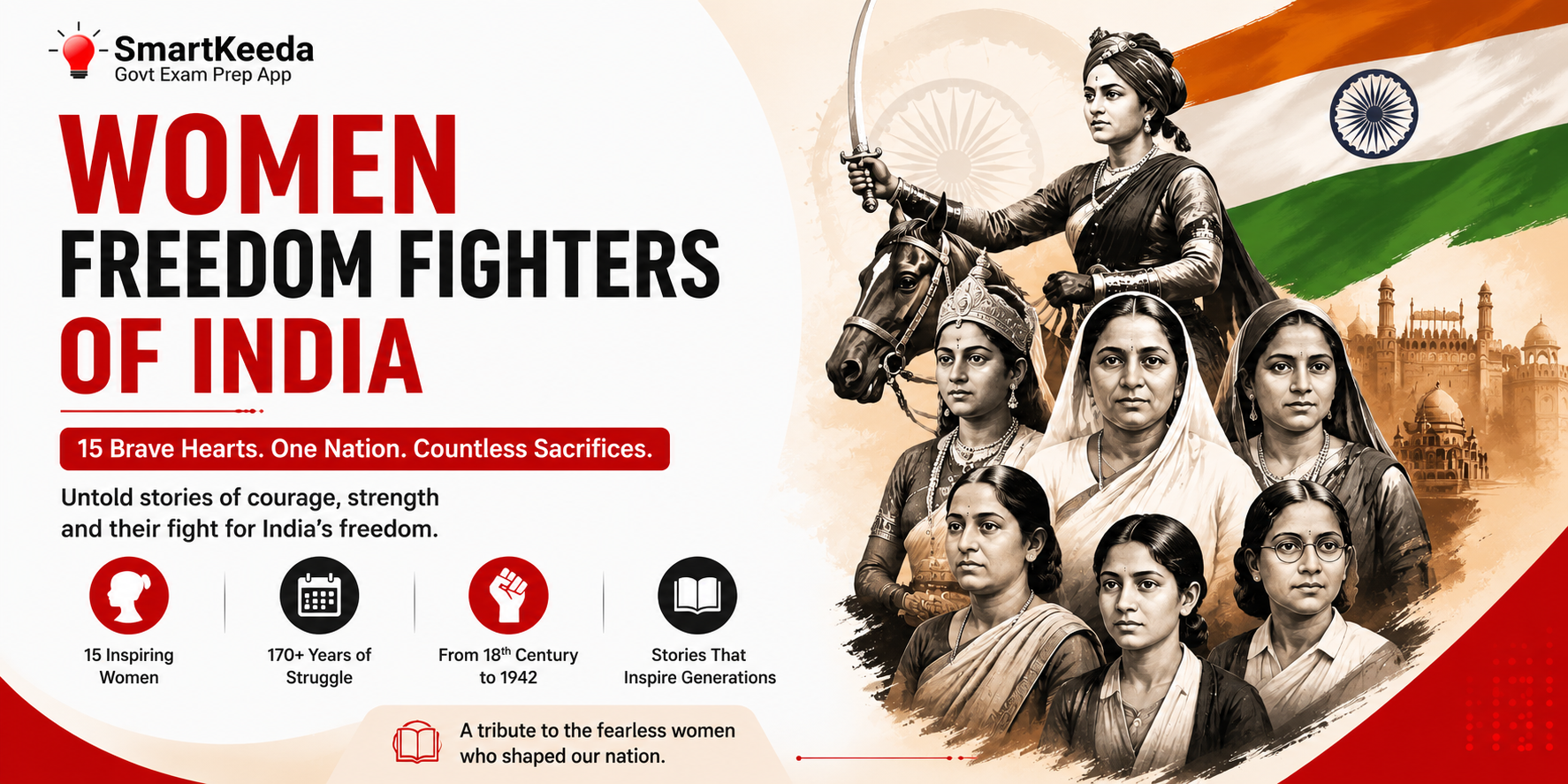
Women Freedom Fighters of Indian
Women freedom fighters of India were active participants — not passive supporters — in every major phase of the independence movement, from armed uprisings in the 18th century to the Quit India Movement of 1942. Their contributions ranged from leading armies and assassination attempts to organizing underground radio stations, hunger strikes, and mass protests.
The involvement of women began well before the First War of Independence in 1857. Queens such as Velu Nachiyar and Rani Chennamma took up arms against the British East India Company as early as the 1780s, decades before the term "freedom struggle" was even in common use. This long, often overlooked history is why understanding the full range of female freedom fighters of India matters — it corrects a narrative that has traditionally centered on a small set of male leaders.
Who is considered the earliest of these freedom fighters? Rani Velu Nachiyar of Sivaganga (Tamil Nadu) is widely regarded as the first queen to fight the British, retaking her kingdom in 1780. She predates Rani Lakshmibai's 1857 uprising by more than seven decades.
Pactice General knowledge Quizzes
List of Women Freedom Fighters of India - Profile
|
|
Name |
Region |
Era |
Known For |
|
1 |
Rani Velu Nachiyar |
Sivaganga, Tamil Nadu |
1780 |
First queen to defeat the British in battle |
|
2 |
Rani Lakshmibai |
Jhansi |
1857 |
Led the Revolt of 1857 on horseback |
|
3 |
Begum Hazrat Mahal |
Awadh (Lucknow) |
1857 |
Took control of Lucknow, resisted British rule |
|
4 |
Rani Chennamma |
Kittur, Karnataka |
1824 |
One of the earliest armed revolts against the British |
|
5 |
Uda Devi |
Lucknow |
1857 |
Led a Dalit women's militia at Sikandar Bagh |
|
6 |
Madam Bhikaji Cama |
Bombay / Europe |
1907 |
Unfurled India's first flag on foreign soil |
|
7 |
Sarojini Naidu |
Hyderabad |
1917–1947 |
First Indian woman president of the INC |
|
8 |
Kasturba Gandhi |
Porbandar / Gujarat |
1917–1944 |
Led the Satyagraha movement alongside Gandhi |
|
9 |
Annie Besant |
Madras (adopted India) |
1916–1933 |
Founded the Home Rule Movement |
|
10 |
Kamaladevi Chattopadhyay |
Mangalore |
1923–1947 |
First woman to contest a legislative election in India |
|
11 |
Aruna Asaf Ali |
Kalka, Punjab |
1942 |
Hoisted the flag during the Quit India Movement |
|
12 |
Usha Mehta |
Surat, Gujarat |
1942 |
Ran the underground Congress Radio |
|
13 |
Matangini Hazra |
Midnapore, Bengal |
1932–1942 |
Martyred while leading a Quit India procession |
|
14 |
Kanaklata Barua |
Assam |
1942 |
Youngest martyr of the Quit India Movement, age 17 |
|
15 |
Bina Das |
Bengal |
1932 |
Attempted to assassinate the Bengal Governor |
List of Neighbouring Countries of India
Female Freedom Fighters of India
A brief summary of the Female Freedom Fighters of India has been provided above.
1. Rani Velu Nachiyar (1730–1796)
Rani Velu Nachiyar of Sivaganga is regarded as the first Indian queen to wage a successful war against the British East India Company. After her husband was killed in 1772, she spent years in exile, building alliances with Hyder Ali of Mysore before retaking her kingdom in 1780 — making her, in effect, the earliest known figure on this list. She also pioneered a form of human bomb attack, carried out by her trusted commander Kuyili, against a British arsenal.
2. Rani Lakshmibai (1828–1858)
The Rani of Jhansi remains the most widely recognized among female freedom fighters of India. Trained in swordsmanship and horse-riding from childhood, she refused to hand over Jhansi under the British Doctrine of Lapse and led her troops into battle during the 1857 uprising, dying on the battlefield rather than surrendering.
3. Begum Hazrat Mahal (c.1820–1879)
As the regent of Awadh, Begum Hazrat Mahal took direct control of administration and military strategy after her husband was exiled by the British. She led the resistance in Lucknow during 1857 and continued to organize opposition from Nepal even after the revolt was crushed, refusing offers of a British pension.
4. Rani Chennamma (1778–1829)
Decades before 1857, Rani Chennamma of Kittur (present-day Karnataka) led an armed revolt against the British East India Company in 1824 after it refused to recognize her adopted son as heir. Though eventually captured, her rebellion is remembered as one of the earliest instances of armed resistance to colonial rule in India.
5. Uda Devi (d. 1857)
A Dalit freedom fighter from Lucknow, Uda Devi organized a women's militia known as the "Dalit Viranganas" and fought disguised as a soldier at the Battle of Sikandar Bagh, reportedly killing over 30 British soldiers from a tree before being killed herself. Her story is one that mainstream lists frequently leave out, despite her documented bravery.
6. Madam Bhikaji Cama (1861–1936)
Working largely from exile in Europe, Bhikaji Cama unfurled an early version of the Indian national flag at an international socialist conference in Stuttgart, Germany, in 1907 — declaring India's right to independence on a global stage decades before it was won.
7. Sarojini Naidu (1879–1949)
Known as the "Nightingale of India" for her poetry, Sarojini Naidu became the first Indian woman to serve as president of the Indian National Congress in 1925. She led the Dharasana Salt Satyagraha after Gandhi's arrest and later became the first woman governor of an Indian state post-independence.
8. Kasturba Gandhi (1869–1944)
Often remembered only as Mahatma Gandhi's wife, Kasturba was an independent political force in her own right — leading the Women's Satyagraha, organizing the Champaran movement with indigo workers, and continuing protests even during her imprisonment, where she eventually died in 1944.
9. Annie Besant (1847–1933)
A British-born theosophist who adopted India as her home, Annie Besant founded the Home Rule Movement in 1916 and became the first woman president of the Indian National Congress in 1917, using journalism and public speaking to build mass political awareness.
10. Kamaladevi Chattopadhyay (1903–1988)
A pioneering feminist and freedom fighter, Kamaladevi was the first Indian woman to contest a legislative election. She organized the Salt Satyagraha in Bombay, was arrested multiple times, and later played a major role in reviving Indian handicrafts and theatre after independence.
11. Aruna Asaf Ali (1909–1996)
Known as the "Grand Old Lady of the Independence Movement," Aruna Asaf Ali famously hoisted the Indian National Congress flag at Gowalia Tank in Bombay during the 1942 Quit India Movement, going underground for years afterward to evade arrest.
12. Usha Mehta (1920–2000)
A college student at the time, Usha Mehta set up and ran the secret "Congress Radio" station during the Quit India Movement of 1942, broadcasting messages of resistance for months before being tracked down and arrested by British authorities.
13. Matangini Hazra (1870–1942)
A 73-year-old widow from Midnapore, Bengal, Matangini Hazra was shot dead by British police while leading a procession of nearly 6,000 people to hoist the Indian flag during the Quit India Movement — reportedly continuing to chant "Vande Mataram" even as she fell.
14. Kanaklata Barua (1924–1942)
At just 17 years old, Kanaklata Barua led an unarmed procession in Assam to hoist the national flag at a police station during the Quit India Movement. She was shot and killed on the spot, becoming one of the youngest martyrs on this list.
15. Bina Das (1911–1986)
A Bengali revolutionary linked to the Chhatri Sangha, Bina Das attempted to assassinate the Governor of Bengal, Stanley Jackson, during a convocation ceremony in Calcutta in 1932. She was sentenced to nine years in prison and later joined mainstream Congress politics after her release.

Recent Recognition and Tributes (2024–2026)
Interest in women freedom fighters of India has grown in recent years, with state governments actively commemorating figures who were historically overlooked:
-
In September 2025, the Tamil Nadu government unveiled a statue of Rani Velu Nachiyar inside the state Assembly complex, officially honouring her as one of the earliest woman freedom fighters of India to defeat the British in battle.
-
Postal and cultural institutions have continued to release commemorative stamps and exhibitions on lesser-known freedom fighters, including Uda Devi, Kanaklata Barua, and Bina Das, as part of a broader push to diversify how the independence movement is taught.
-
Several state education boards have added regional freedom fighters — particularly Dalit and tribal women — to school-level history curricula, reflecting growing recognition that the mainstream narrative needs to include more regional and grassroots figures.
Practice free Static GK Quizzes
Common Mistakes Students Make While Studying This Topic
-
Treating 1857 as the starting point. Several figures on this list, including Rani Velu Nachiyar and Rani Chennamma, resisted British rule decades before the 1857 revolt.
-
Focusing only on Congress-aligned leaders. Revolutionary and armed-resistance figures like Bina Das and Uda Devi are just as historically significant but are often left out of standard study material.
-
Mixing up similar names and titles. Kasturba Gandhi, Kamala Nehru, and Kamaladevi Chattopadhyay are frequently confused with one another in exams because of overlapping timeframes and similar-sounding names.
-
Ignoring regional freedom fighters. Most lists lean heavily toward North Indian and Bengali figures, overlooking equally important heroines from Tamil Nadu, Karnataka, Assam, and other regions.
Key Takeaways
-
Indian women resisted British rule from as early as 1780, well before the 1857 revolt that is commonly taught as the starting point of organized resistance.
-
This list intentionally includes lesser-known figures like Uda Devi, Kanaklata Barua, and Bina Das, alongside widely recognized names like Rani Lakshmibai and Sarojini Naidu.
-
women freedom fighters of India came from every region and background — queens, students, widows, and revolutionaries — and used methods ranging from armed rebellion to underground broadcasting and civil disobedience.
-
Recognition of these women continues to evolve, with new statues, stamps, and curriculum changes still being introduced as recently as 2025–2026.

SBI PO Mains 2026 GA Analysis (12 Sep)
SBI PO Mains 2026 GA Analysis (12th September 2026): 75% Questions Directly Covered from CA MockDrill
14 Sep 2026

IBPS PO Prince Success Story
From Reserve List to IBPS PO Selection: Prince's Journey with Smartkeeda
5 Sep 2026

Prerna Mahor Success story
How Prerna Mahour Cracked SBI Clerk & IBPS Clerk Together with Private Job
20 Jul 2026

Women Freedom Fighters of India
15 Women Freedom Fighters of India: The Untold Stories of Courage (1780–1947)
18 Jul 2026