

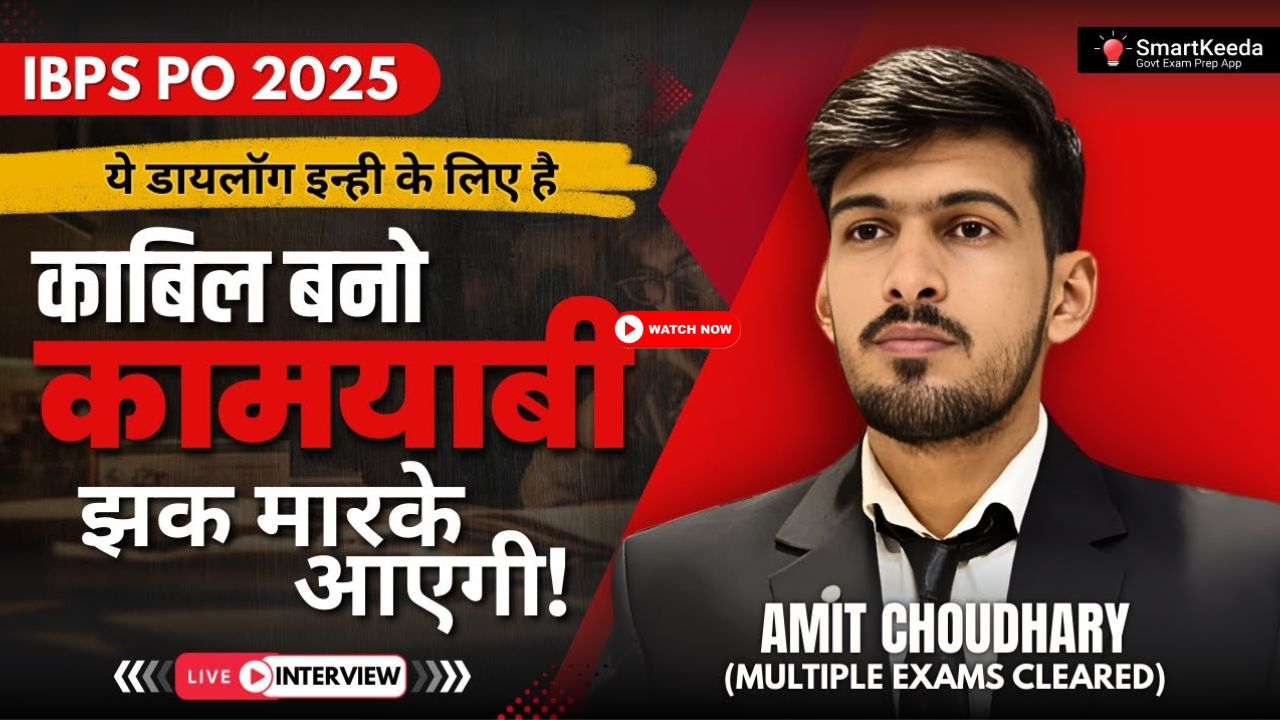
Success Story of IBPS PO Amit Choudhary 2025

Introduction: IBPS PO Amit Choudhary
Being selected as a probationary officer at one of India's leading public sector banks is something every banking aspirant has dreamed of. However, for most people, this dream becomes a nightmare when they face failure at several points along their journey.
Amit Choudhary's journey can be termed a example of how pure discipline, precise monitoring, and 'data-driven approach' can conquer early failure and ultimately lead to stupendous success.
From failing to crack even preliminary exams to clearing multiple mains exams and finally landing a job at the Bank of India as an IBPS PO, Amit's story truly stands as a living example of how smartness will always triumph over blind hard work.
How Amit Started His Banking Journey
Amit started his government exam preparation journey right after completing his graduation in December 2020
Like many college graduates, he started with a generic goal: he wanted a government job, but had no clear blueprint or specific exam in mind.
"I just knew I wanted to prepare for government exams. It was actually a friend who introduced me to banking exams and suggested I give them a shot." — Amit.
Amit started from scratch as he had no prior guidance or knowledge regarding any aspect of preparation. In the initial phase, Amit only dealt with preliminary-level basic questions.
Having a Hindi-medium educational background, Amit faced many problems and was unable to perform well in the English section. He had no master plan and was not aware of the huge challenge he was up against in cracking the mains examination.
Early Failures & Struggles in Banking Exams
Amit’s initial journey was not easy. In the beginning, he couldn’t clear most of his prelims exams due to a lack of holistic planning. In his earlier attempts, the only good thing was that he cleared the IBPS PO prelims, but he couldn’t get final selection as he did not have mains-focused preparation.
However, things started improving gradually.
During 2023:
-
He cleared the SBI PO Mains.
-
He cleared IBPS PO Mains.
-
He cleared IBPS Clerk Mains.
He cleared many of the prelims and mains examinations, but, unfortunately, he could not make it to the final merit list. It was a mentally challenging period for him, however Amit adopted a different approach, he did not succumb to frustration. Instead, he resolved to take lessons from each of his failures.
The Decision That Changed His Preparation
After receiving multiple disappointing results in 2023, Amit made a crucial decision. Instead of waiting for official notifications to drop, he decided to start preparation early.
He realized his biggest mistake in the previous attempt was the "pre-to-mains gap," i.e., waiting for prelims results before studying for the mains. Amit understood that because the gap between the prelims and mains exam is incredibly short, approximately 20 days, which is very little time to clear the mains phase. So he started balancing pre and mains from the start.
He focused on:
-
Daily practice
-
Mock analysis
-
Strengthening weak areas
-
Improving accuracy
This approach ensured that whenever a notification arrived, he was already exam-ready, accelerating his progress.
From Baroda UP Gramin Bank to SBI Junior Associate
Amit’s first major breakthrough came as he ended his streak of failures when he cleared the exam of Baroda UP Gramin Bank. He got that first selection letter, and it was a great relief. He joined the rural bank proudly to start his banking career. However, as he wanted better opportunities, he resigned after 45 days of the job to join SBI as a Junior Associate in July 2025.
Studying for the tough PO exam while working a tough 9-to-5 job at an SBI branch was a challenging job. He was totally wiped out by the time he got home from his evening commute. He wanted to continue his preparation without burning out, so he changed his strategy during this time.
-
No more tutorials: He already knew the concepts from previous years of study. He stopped watching online basic classes or reading theory books. He wanted to utilize his time more efficiently.
-
Straight to practice: Every spare hour outside the office was spent in practice – solving sectional speed drills and grinding through tough mock tests.
-
Maximizing short hours: Rather than freaking out over not having 6 hours to study, he put all of his energy into making the 2 hours he had in the evening as intense and error-free as possible.
Amit’s Step-by-Step English Improvement Strategy
If there's one thing that truly shows Amit's determination, it's the gradual progress he made in the English section. He came from a rural background, had gone to a pure Hindi-medium school, and even wrote his college chemistry papers in Hindi. English was initially a major challenge for him.
Instead of jumping into complex editorials like The Hindu or The Economist (a mistake most Hindi background aspirants make, which discourages them), Amit built a gradual ladder of improvement:
He followed this step-by-step plan to improve his English
Step 1: Reading Champak Comics
He started with reading English content, such as Champak comics. Champak comics help him get familiar with the language, and they develop his reading habits and basic confidence.
Step 2: Moved to Panchatantra Stories
After gaining some confidence with Champak comics, he moved to Panchatantra stories. Panchatantra stories offered slightly advanced language that helped him understand Better sentence structures and improved his comprehension ability.
Step 3: Start basic Newspapers
He started with reading the basic level of news with Hindustan Times. Hindustan Times helped him understand editorial writing, formal English language, and he got familiar with current affairs language.
Step 4: Advanced Reading
After developing a strong foundation and confidence, Amit moved to reading advanced-level editorial such as “The Hindu”, “The indian express,”, etc
This gradual learning progression helped him improve steadily without frustration and disappointment.
How Mock Test Analysis Improved His Scores
The reason for Amit's improvement in performance did not lie in the huge number of mock tests he took, but in the ruthless way in which he dissected them. He didn’t just look at his overall score and move on; he used his mock tests as a diagnostic tool to fix his weaknesses.
This is simply how his analysis strategy influenced his scores:
1. The “Mock Diary” Routine: Amit didn’t rely on online mock analysis dashboards. He kept a physical notebook, in which he physically wrote down each and every mock test that he gave. He used to jot down the platform name, section-wise marks, rank, and percentile to see his real growth over a span of time.
2. The Power of the “Remarks” Column: Next to each mock test entry, he wrote an honest summary of why he had lost marks. If he lost marks in Quant or Reasoning, he would write notes like: “Lost 6 minutes trying to solve an unattempted puzzle.” This reminder in his mind prevented him from repeating the same tactical mistakes in the next test.
3. Speed and Error Drills as Goals: Amit didn’t just passively watch marathon video classes on YouTube. He used the analysis to pinpoint exact weak points. He would open sectional speed drills immediately (such as Smartkeeda’s) and actively practice under a ticking timer until that flaw was eradicated.
4. Strategic Mock Preservation: He didn’t go through his best mock tests just to practice. Amit strategically kept high-quality, exam-relevant mock tests for the ultimate benchmarks. He only used them to assess his actual exam readiness, pacing, and emotional control under realistic pressure.
Managing YouTube Alongside Bank Preparation
Here is the complete strategy of balancing both YouTube and bank exam preparation.
|
Strategy |
What Amit Did |
How It Helped |
|
Positive Accountability |
Shared study routines, daily progress, and mock test scores on YouTube. |
Subscribers kept him accountable, motivating him to stay consistent. |
|
Practiced What He Preached |
Publicly analyzed his mock tests and discussed mistakes. |
Forced him to remain disciplined because viewers would notice repeated errors. |
|
Documented, Not Vlogged |
Recorded his actual preparation process instead of creating highly edited content. |
Saved time while providing authentic insights into his exam journey. |
|
Preparation First, Content Second |
Ensured recording and editing never interfered with study hours. |
Helped him stay focused on his ultimate goal—securing a bank job. |
How Smartkeeda Mock Tests Helped Amit
Real Exam-Level Questions: Amit recalled that during his IBPS Clerk mains exam in 2023, he encountered the same type of questions he had practiced in Smartkeeda mocks before. He distinctly remembers that the real exam questions and difficulty level were exactly the same as what he had faced on Smartkeeda.
Learning Beyond Scores: One thing that really helped him was the quality and exam-oriented nature of the questions. Smartkeeda mock tests introduced him to different patterns of questions, different levels of difficulties, which helped him to know his weak areas and work on them systematically. Most importantly, Amit analyzed himself after each test, rather than simply looking at his score. He carefully reviewed his mistakes, where he lost time, focused on his weak areas, and changed his approach accordingly.
Active practice vs. passive video watching: Amit noticed that a lot of aspirants spend hours passively watching the YouTube videos of teachers solving questions. To break that habit, he depended heavily on the English Speed Drills and Error Drills of Smartkeeda. This made him solve questions actively against the clock, and this is exactly how he improved on speed and accuracy.
Strategic attempting of mocks: Amit did not burn through his mocks mindlessly for the sake of attempting mocks. Knowing that Smartkeeda mocks are exam-relevant and very close to the actual mains level, he saved them strategically. He would work on other basic platforms for just topic practice, but he saved his Smartkeeda tests for the ultimate benchmark to evaluate exactly where he stood in terms of exam readiness.
Quizzes for better active recall: For current affairs, Amit wasn't a fan of reading and highlighting huge PDFs endlessly. He liked to read the weekly compilation fast and then directly jump to the mock drills and quizzes of Smartkeeda. It activated his brain to struggle and recall information and made sure he didn't freeze up when it came to the general awareness section of the mains.
Key Practices Behind Amit’s Banking Success
Amit has cracked several exams one after another, from RRB and SBI Clerk to the final IBPS PO selection. There was no secret shortcut. He just developed a few simple, non-negotiable habits that most aspiring candidates completely overlook.
Active Recall vs Infinite re-reading: Amit didn’t sit and mark huge PDFs for hours when it came to General Awareness. He knew that passive reading tricks your brain into thinking it remembers everything when it
doesn't. Instead he’d just skim through a weekly PDF quickly and then straight into quizzes. It was the forcing of his brain to actively struggle and remember the answers under a timer that did the trick.
The “Don’t Make The Same Mistake Twice” Rule: For Amit, a mock test was a complete waste if not analysed properly. He wrote down his mistakes in a real notebook, and before the next test, he would look at the “Remarks” column, so he didn’t waste time repeating the same tactical screw-ups twice. Each wrong answer was a direct lesson in what not to do in the exam hall.
Real Practice Over Passive Video Binging: Watching a teacher solve puzzles or error question on YouTube for 3 hours, it is super easy to feel productive. Amit knew he walked into a trap. to learn actively and retain information, He cut back on video consumption and focused his energy on active practice: targeted speed drills and sectional tests to build his muscle memory.
Interview Mistakes That Amit Learned From
A number of aspirants feel that a good score in the mains exam will automatically secure their selection. Amit learnt the hard way that the interview process can literally make or break the chances of selection. He scored a massive 13+ marks above the mains cut-off in his 2024 IBPS PO, but could not get into final merit list due to his poor performance in the interview.
Amit did not fall back; he learnt from his mistakes and improved. Below are the critical things he did wrong and how he fixed them to ace his final interview
Mistake 1: Trying to cover up the Prep Gap
In his 2024 interview, Amit tried to gloss over the years he spent preparing after graduating in 2021. He couldn't give a straight answer about what he was doing all those years, so the panel decided to grill him all about his graduation subject - Computer Science. He hadn't touched his college books in years, and he was not ready for technical academic questions.
Solution: In his successful interview, He told the panel confidently that he has been working as a Junior Associate at SBI for the last five months. He was honest about his current life and offered the panel something to talk about.
Mistake 2: Ruining His Confidence With the “Sorry” Loop
Amit struggled through that difficult 2024 interview, unable to answer a series of technical questions. He ended up saying "Sorry, Sir" to almost seven or eight questions consecutively. He felt the mounting pressure and panicked so much that when they finally asked him a question he actually knew the answer to (about the Financial Action Task Force or FATF), his nerves were shattered and he blanked out and said sorry yet again.
Solution: In the introduction, Amit actively brought out his practical experience at SBI and set the pitch on which he wanted to play. They asked him a lot of questions about his real job at the bank. KYC, opening savings accounts, stuff like that. Basic SBI history. He worked through this stuff every day at his branch so he could answer smoothly and make a fantastic impression.
Amit Choudhary’s Final Advice for Banking Aspirants
After years of preparation, numerous setbacks, and finally success, Amit realized a simple fact. Clearing banking exams is not just about being super intelligent. It’s about being smart enough to find your own mistakes and having the discipline to fix them every single day.
Looking back, he thinks many of the talented hopefuls quit too soon. A few failed prelims, a missed mains cut-off, or an unsuccessful interview often make them believe that they are not the one for the exam. Amit's experience was to prove otherwise. Every setback has something valuable to teach if you're willing to honestly analyze what went wrong and improve.
These are the principles that guided him in all his journey:
-
Consistency is the key, irrespective of the short-term results: A bad mock test or a failed attempt does not define your potential.
-
See failures as feedback, not a final verdict: Every mistake can teach you something that moves you closer to success.
-
Go through each mock test meticulously. The real work begins after the test, not during it.
-
Work on your weaknesses, don’t ignore them: The areas you struggle with are often the best opportunities to improve your score.
-
Develop solid fundamentals before trying to find advanced tricks and shortcuts: Strong fundamentals make all topics easier to learn.
-
Trust the process and give yourself time to grow: Big jumps forward don’t happen overnight.
-
Do not compare your journey with others: Different aspirants have different starting points. Different strengths, different timelines.
Amit strongly feels that “there is no one-size-fits-all timeline to success.” Some candidates achieve their goals the first time, and others take years of dedicated effort. Neither one is better in itself. What matters is being able to continue learning, to be able to adapt to setbacks, and to keep going when things don't go as expected.
His own story is proof of this. Amit was a student who struggled with the English section initially; it was very tough for him to clear prelims in the initial few attempts. He kept trying and was disappointed a lot, but he did not lose hope. He worked on his mistakes, improved steadily, and eventually cleared multiple exams with ease.

SBI PO Mains 2026 GA Analysis (12 Sep)
SBI PO Mains 2026 GA Analysis (12th September 2026): 75% Questions Directly Covered from CA MockDrill
14 Sep 2026

IBPS PO Prince Success Story
From Reserve List to IBPS PO Selection: Prince's Journey with Smartkeeda
5 Sep 2026

Prerna Mahor Success story
How Prerna Mahour Cracked SBI Clerk & IBPS Clerk Together with Private Job
20 Jul 2026

Women Freedom Fighters of India
15 Women Freedom Fighters of India: The Untold Stories of Courage (1780–1947)
18 Jul 2026