

List of Prime Ministers of India (1947–2026): Tenure & Facts

The Prime Minister is the real executive head of India's government, even though the President is the constitutional head of state. Under Articles 74 and 75 of the Constitution, the President appoints the Prime Minister — but only the leader who can command a majority in the Lok Sabha gets the job, and the Council of Ministers stays in office only as long as it holds that majority's confidence.
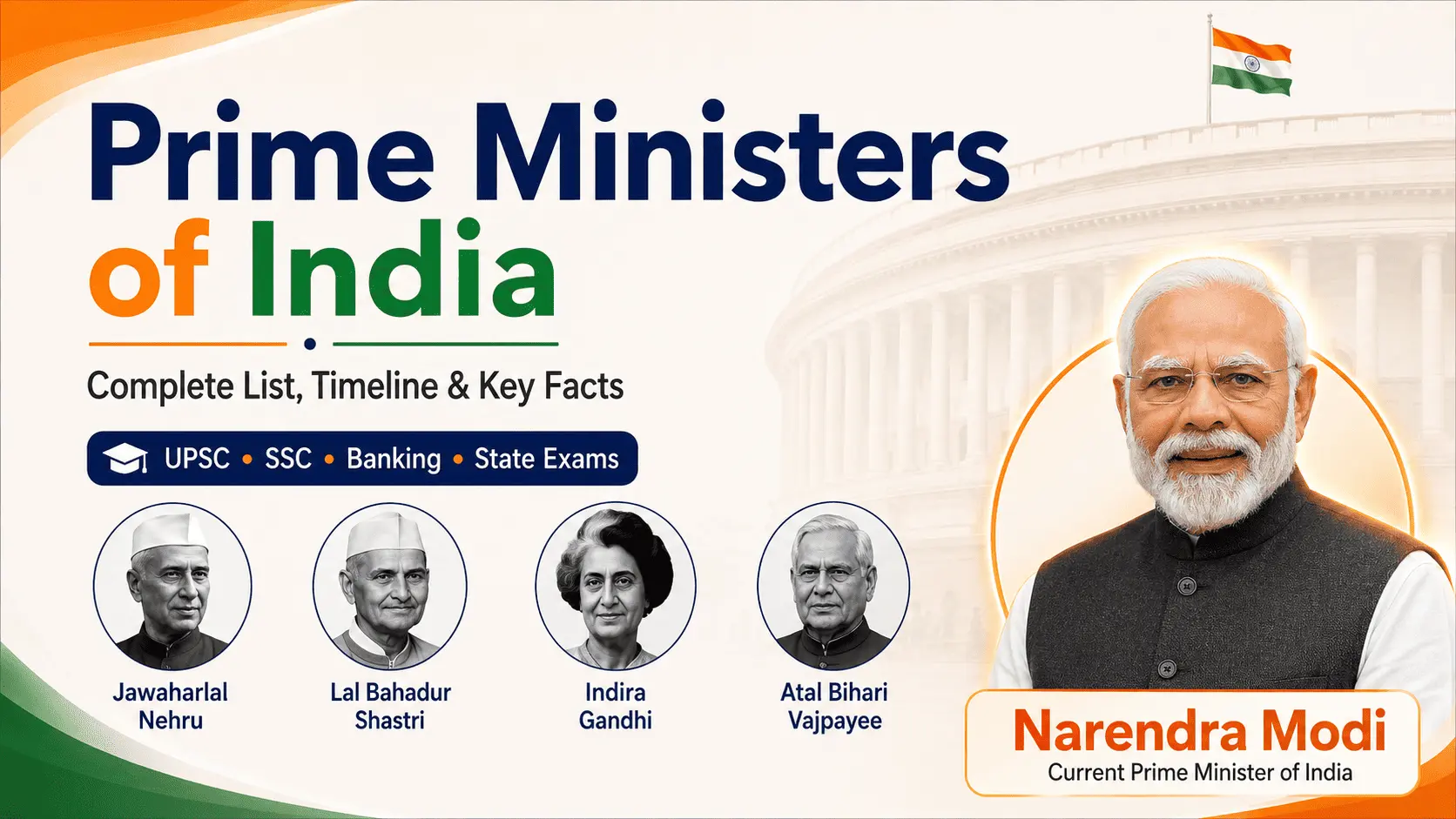
Full List of Prime Ministers of India with Tenure
This List of Prime Ministers of India is one of the highest-yield static GK topics across competitive exams, because it links constitutional design (Articles 74–75), modern Indian political history, and current affairs (the sitting PM) into a single, frequently tested thread.
Aspirants, who are preparing for competitive exams, should focus on four things: the exact chronological order, unique "firsts," tenures that ended in death or resignation, and terms that ran non-consecutively.
| No. | Prime Minister | Term(s) of Office | Party |
| 1 | Jawaharlal Nehru | 15 Aug 1947 – 27 May 1964 | Indian National Congress |
| — | Gulzarilal Nanda (Acting) | 27 May 1964 – 9 Jun 1964 | Indian National Congress |
| 2 | Lal Bahadur Shastri | 9 Jun 1964 – 11 Jan 1966 | Indian National Congress |
| — | Gulzarilal Nanda (Acting) | 11 Jan 1966 – 24 Jan 1966 | Indian National Congress |
| 3 | Indira Gandhi | 24 Jan 1966 – 24 Mar 1977; 14 Jan 1980 – 31 Oct 1984 | Indian National Congress |
| 4 | Morarji Desai | 24 Mar 1977 – 28 Jul 1979 | Janata Party |
| 5 | Charan Singh | 28 Jul 1979 – 14 Jan 1980 | Janata Party (Secular) |
| 6 | Rajiv Gandhi | 31 Oct 1984 – 2 Dec 1989 | Indian National Congress |
| 7 | V. P. Singh | 2 Dec 1989 – 10 Nov 1990 | Janata Dal |
| 8 | Chandra Shekhar | 10 Nov 1990 – 21 Jun 1991 | Samajwadi Janata Party |
| 9 | P. V. Narasimha Rao | 21 Jun 1991 – 16 May 1996 | Indian National Congress |
| 10 | Atal Bihari Vajpayee | 16 May 1996 – 1 Jun 1996; 19 Mar 1998 – 22 May 2004 | Bharatiya Janata Party |
| 11 | H. D. Deve Gowda | 1 Jun 1996 – 21 Apr 1997 | Janata Dal |
| 12 | I. K. Gujral | 21 Apr 1997 – 19 Mar 1998 | Janata Dal |
| 13 | Manmohan Singh | 22 May 2004 – 26 May 2014 | Indian National Congress |
| 14 | Narendra Modi | 26 May 2014 – Incumbent | Bharatiya Janata Party |
Note: Vajpayee's second and third stints (1998–1999 and 1999–2004) are combined above for readability but are sometimes listed as separate terms following the 1999 general election.
Who Was the First PM of India?
Jawaharlal Nehru was the first Prime Minister of India, taking oath on 15 August 1947, the very day the country gained independence. He went on to serve continuously for almost 17 years, until his death in office in May 1964 — a tenure no successor has matched.
Nehru's time in office laid the institutional groundwork for modern India: the Constitution came into force under his leadership in 1950, he launched the Five-Year Plans to guide economic development, championed a foreign policy of non-alignment during the Cold War, and pushed for the creation of scientific and technical institutions that still shape the country today. His daughter, Indira Gandhi, would later become India's only woman Prime Minister, continuing the family's outsized role in Indian politics.
Because "who was the first PM of India" is such a common search and exam question, it's worth remembering the follow-up fact examiners like to pair with it: Nehru is also the longest-serving PM, so questions sometimes test both facts together as a trick pairing.
Profile of Key Prime Ministers
1. Lal Bahadur Shastri (1964–1966)
Best remembered for the wartime slogan "Jai Jawan Jai Kisan" during the 1965 India-Pakistan war, Shastri died shortly after signing the Tashkent Declaration, making his tenure one of the shortest full terms in the list.
2. Indira Gandhi (1966–1977, 1980–1984)
India's only woman Prime Minister to date, Indira Gandhi served two non-consecutive terms marked by the nationalisation of banks, the 1971 war that led to Bangladesh's independence, and the imposition of the Emergency (1975–1977). She was assassinated in October 1984.
3. Morarji Desai (1977–1979)
The first non-Congress Prime Minister, Desai came to power after the Emergency ended, at the head of the newly formed Janata Party — a landmark moment showing that Congress's early dominance was not permanent.
4. Charan Singh (1979–1980)
Unique among all Indian PMs: Charan Singh never once faced Parliament for a confidence vote during his entire tenure, making him a frequent subject of "unusual facts" exam questions.
5. P. V. Narasimha Rao (1991–1996)
Widely regarded as the architect of India's 1991 economic liberalisation, Rao appointed Manmohan Singh as Finance Minister and became the first Prime Minister from South India, as well as the first non-Nehru-Gandhi PM to complete a full five-year term.
6. Atal Bihari Vajpayee (1996; 1998–2004)
Vajpayee's first term lasted only 13 days — the shortest of any PM — but his later terms saw the 1998 Pokhran-II nuclear tests and made him the first non-Congress PM to complete a full five-year term.
7. Manmohan Singh (2004–2014)
An economist by training, Manmohan Singh became India's first Sikh Prime Minister and is credited with steering major economic and social legislation, including the Right to Information Act and MGNREGA.
8. Narendra Modi (2014–present)
India's current Prime Minister and the first to be born after independence, Narendra Modi has now won three consecutive general elections (2014, 2019, 2024), making him the longest-serving non-Congress Prime Minister in the country's history.
Acting Prime Ministers — A Detail Exams Love to Test
Gulzarilal Nanda served as Acting Prime Minister twice — for about two weeks after Nehru's death in 1964, and again for about two weeks after Shastri's death in 1966. Both times, he stepped aside once a permanent successor was chosen by the Congress party. Because he never held the post through a general election mandate, Nanda is not included in the official numbered list of 14 Prime Ministers, similar to how acting heads of state are excluded from official President or Governor counts elsewhere in Indian polity.
This is a frequent exam trap: some sources casually list "15 or 16 Prime Ministers" by mistakenly counting Nanda's two acting stints as separate entries.
Pactice General knowledge Quizzes
How the Prime Minister of India Is Appointed
- General elections are held for the Lok Sabha every five years (or earlier, if dissolved).
- The party or coalition with a majority stakes its claim to form the government.
- The President formally appoints the leader of that majority as Prime Minister, under Article 75.
- The Prime Minister then recommends other ministers, who are appointed by the President on the PM's advice.
- The government remains in office only as long as it retains the confidence of the Lok Sabha.
Powers and Functions of the Prime Minister
- Chairs the Council of Ministers and sets the overall direction of government policy
- Principal channel of communication between the Cabinet and the President
- Controls ministerial appointments, reshuffles, and portfolio allocation
- Represents India internationally at summits and bilateral meetings
- Chairs key bodies such as NITI Aayog and various Cabinet Committees
- Advises the President on the exercise of significant executive decisions
Key Facts and Records Every Aspirant Should Know
| Distinction | Prime Minister |
| First Prime Minister of India | Jawaharlal Nehru |
| Longest-serving PM | Jawaharlal Nehru (nearly 17 years) |
| Shortest-serving PM (full term) | Atal Bihari Vajpayee (13 days, 1996) |
| Shortest-serving PM (never faced Parliament) | Charan Singh |
| Only woman Prime Minister | Indira Gandhi |
| First non-Congress PM | Morarji Desai |
| First PM from South India | P. V. Narasimha Rao |
| First Sikh Prime Minister | Manmohan Singh |
| First PM born after independence | Narendra Modi |
| PMs who died in office | Jawaharlal Nehru, Lal Bahadur Shastri, Indira Gandhi (assassinated), Rajiv Gandhi (assassinated) |
| Current Prime Minister | Narendra Modi |
| Total Prime Ministers to date | 14 |
Prime Minister vs President: Key Differences
A common point of confusion for aspirants. Here's a quick side-by-side:
| Aspect | Prime Minister | President |
| Type of head | Real/executive head | Nominal/ceremonial head |
| Appointed by | President (Article 75) | Elected by Electoral College |
| Term | No fixed term; depends on Lok Sabha majority | Fixed 5-year term |
| Real power | Exercises actual executive authority | Acts on PM's advice (Article 74) |
| Removal | Loses office on losing Lok Sabha confidence | Removed only by impeachment |
| Accountability | Answerable to Parliament | Not directly answerable to Parliament |
List of President of India
Prime Ministers Who Also Served as Chief Ministers
Several PMs built their national careers on a foundation of state leadership — a detail exams like to cross-test with state-level GK:
- Narendra Modi: Chief Minister of Gujarat (2001–2014) before becoming PM
- Morarji Desai: Chief Minister of Bombay State (1952–1956) before later becoming PM
- P. V. Narasimha Rao: Chief Minister of Andhra Pradesh (1971–1973) before becoming PM
This state-to-centre career path is far more common among PMs than most static GK guides highlight.
Coalition Era: 1989–2014 in Focus
Between Rajiv Gandhi's exit in 1989 and Narendra Modi's decisive majority in 2014, India was governed almost entirely by coalition governments — a 25-year stretch that reshaped how the Prime Minister's office functioned:
- 1989–1999: Six different Prime Ministers in a decade (V. P. Singh, Chandra Shekhar, Rao, Vajpayee×2, Deve Gowda, Gujral)
- 1999–2004: NDA coalition under Vajpayee — the first coalition government to complete a full term
- 2004–2014: UPA coalition under Manmohan Singh, across two terms
Understanding this coalition era helps explain why so many PMs on the list served unusually short terms — it wasn't personal failure, but the arithmetic of shifting alliances.
Prime Ministers Awarded the Bharat Ratna
India's highest civilian honour has gone to several PMs, either during or after their tenure — a fact frequently paired with "Bharat Ratna recipients" GK questions:
| Prime Minister | Year Awarded |
| Jawaharlal Nehru | 1955 |
| Lal Bahadur Shastri | 1966 (posthumous) |
| Indira Gandhi | 1971 |
| Rajiv Gandhi | 1991 (posthumous) |
| Morarji Desai | 1991 |
| P. V. Narasimha Rao | Not awarded during his lifetime; conferred posthumously in 2024 |
| Atal Bihari Vajpayee | 2015 |

SBI PO Mains 2026 GA Analysis (12 Sep)
SBI PO Mains 2026 GA Analysis (12th September 2026): 75% Questions Directly Covered from CA MockDrill
14 Sep 2026

IBPS PO Prince Success Story
From Reserve List to IBPS PO Selection: Prince's Journey with Smartkeeda
5 Sep 2026

Prerna Mahor Success story
How Prerna Mahour Cracked SBI Clerk & IBPS Clerk Together with Private Job
20 Jul 2026

Women Freedom Fighters of India
15 Women Freedom Fighters of India: The Untold Stories of Courage (1780–1947)
18 Jul 2026