

Success Story of IBPS PO 2025 Topper Pratham Chopra | Bank Exams

You always have more time than you think."
— Pratham Chopra, IBPS PO & NICL AO 2025
Introduction of IBPS PO Pratham Chopra
“You always have more time than you think.” – Pratham Chopra.
It’s a line most aspirants won’t believe at first. When you’re in the middle of preparation, it always feels like time is slipping away – syllabus piling up, mocks going wrong, and this constant anxiety that you’re already late. Many rush, skip the basics, and keep chasing speed without direction.
But Pratham Chopra's example suggests that maybe time isn't really a problem – it is an illusion we create and feed off of.
Pratham Chopra’s success story is an inspiration for every bank exam aspirant. Coming from a middle-class family in Faridabad, he graduated from Delhi University in 2022 and started preparing for government exams. During his journey, he faced multiple setbacks, including missing final selection in IBPS PO despite reaching the interview and mains stages. Along with preparation, he also managed a job, which made balancing studies and work difficult.
In 2025, Pratham made the bold decision to quit his job and focus completely on his preparation. With better strategy, concept clarity, and focused practice, his hard work finally paid off. He successfully cleared both IBPS PO 2025 and NICL AO 2025, proving that patience, dedication, and the right approach are the real keys to success.
How Pratham Chopra balanced Job and Preparation
Pratham had to face constant struggle, confusion, and stress while he was juggling between his job and studies. After a full day at work, he would return home with plans to study, but his body and mind had already given up for the day.
And that’s what made it frustrating.
Because deep down, he wanted to study more. He knew what needed to be done. But wanting to do it and being able to do it are two very different things when you’re tired all the time.
| Challenges of Dual Focus | |
| At work | While studying |
| He kept thinking about studies. | He felt too tired because of work. |
On the other hand, when he tried to focus more on studies, work started to feel like a burden. His mind was constantly divided—half here, half there.
This constant back-and-forth slowed his preparation and began to affect his confidence, too. There was always this lingering doubt: “Am I doing the right thing?”
With time, he realized something important—this wasn’t balance, it was confusion.
He wasn’t moving forward the way he wanted to. And more than anything, he lacked clarity.
That’s when he made a tough call.
In 2025, he decided to leave his job and give his preparation a fair chance. It wasn’t a comfortable decision. There was stress, confusion, and plenty of overthinking beforehand.
However, after taking that decision, things began to shift around.
For the first time, he was able to sit down and study without feeling completely exhausted. He had the energy to concentrate, the time to get better, and most importantly, a path to follow.
Advice to Aspirants for Preparation and Exam Strategy
When asked about the advice Pratham would give to aspirants, he didn’t share anything complicated or fancy. Instead, he spoke about a mistake almost everyone makes—including himself.
He said, “You always have more time than you think.”
Most aspirants are always in a hurry. They don't complete their basics properly, rush through questions without analyzing them, and weak areas never really improve. When basics aren't clear, every new question feels harder.
His advice is simple:
1. Don’t rush your preparation
2. Give proper time to the basics
3. Face your weak areas instead of avoiding them
4. Don’t solve questions just for the sake of completing them
Give yourself some breathing space. You can't treat yourself like a machine. There will be days when your mind feels heavy, when things don't click — and that's okay. Taking small breaks actually helps you come back stronger. Another thing he emphasized was giving yourself some breathing space.
Preparation is not just about how many hours you study. It's about how well you are prepared.

Challenges Faced During Mains and Final Interview
Here are some of the key challenges that Pratham Chopra faced during the mains exam and final interview stage.
1. General Awareness was the toughest section
Pratham admitted that GK in mains was the most challenging part of his preparation.
2. Low confidence during mains preparation
He often felt unsure about clearing mains because of weak preparation in certain sections.
3. Balancing job with preparation
Managing a private job along with studies created mental pressure and affected focus.
4. Overthinking and lack of clarity
He frequently questioned his strategy, which impacted his exam performance.
5. Fear of lengthy mains questions
Initially, he used to get intimidated by complex and lengthy questions.
6. Difficulty maintaining consistency
There were phases when stress and exhaustion made regular preparation difficult.
7. Weakness in analyzing mock performance
Although he attempted mocks regularly, he sometimes skipped detailed analysis.
8. Accuracy issues in earlier attempts
Over-guessing in exams led to negative marking and missed opportunities.
9. Pressure of repeated setbacks
Missing final selection after reaching advanced stages tested his patience and confidence.
10. Interview stage disappointment
Reaching the IBPS PO interview but not making the final list was one of his biggest setbacks.
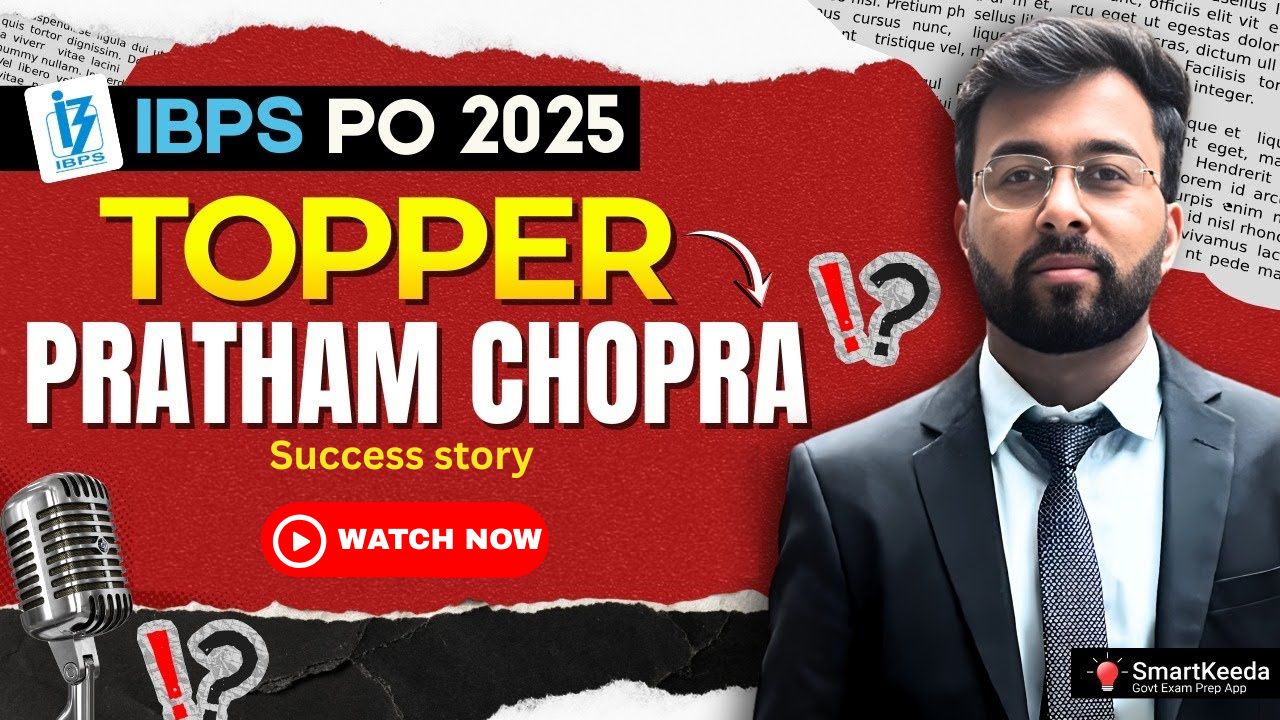
Watch IBPS PO Topper Pratham Chopra’s Success Story Video
Watch IBPS PO topper Pratham Chopra share his preparation strategy, challenges, and success journey to crack the exam,
Smart Strategy to Skip 10 Questions in the Mains Exam
Most aspirants walk into the exam hall believing they need to attempt everything. Pratham thought differently.
For him, the goal was never to touch every question. The goal was to score better than others without ruining accuracy.
And that completely changed the way he approached the paper.
He admitted that there were certain questions he would intentionally leave. Not because he couldn’t solve them, but because he knew they could waste time, create confusion, and increase negative marking.
His strategy was very clear:
-
Don’t chase every question
-
Don’t let ego decide your attempts
-
Protect your accuracy at all costs
Quant
he was very selective. The moment he saw lengthy caselets or questions filled with variables and complicated data, he preferred to move ahead. According to him, some questions consume too much time for very little return.
He especially avoided:
-
Long caselet DI
-
Confusing arithmetic setups
-
Variable-based questions
Reasoning
There was one area he never trusted completely – critical reasoning. He said that this section often led him toward negative marking. So instead of forcing himself to solve it just because it was there, he chose to skip it.
At the same time, puzzles were his strength. And that’s where he focused his energy.
English
he stayed practical. If a parajumble looked messy or a passage felt unnecessarily complex, he moved on without wasting time trying to force an answer. Vocabulary questions without proper context were also something he avoided.
That's something many aspirants forget during exams – your job is not to prove you can solve everything. Your job is to maximize marks.
Blind guessing can destroy an otherwise good paper. Sometimes leaving a question is actually the smarter decision.
Pratham’s approach teaches an important lesson – selection in Mains is not about attempting the highest number of questions. It’s about making smart decisions under pressure.
The Impact of Regular Mock Tests on Pratham Chopra’s Success
One consistent thing that Pratham maintained throughout his preparation journey was giving mocks.
He said, "he can leave any topic for the day, but never leave mocks."
It can be a prelims mock, sectional, or mains mock; he was firm in his preparation that he would not ignore mocks in any circumstances. And that habit eventually became a great boon in his journey, as it improved his speed. He identified his weakness and worked on it, and in the end, it gave him the confidence he needed the most.
How Ego and False Confidence Affect Your Preparation
Pratham told Smartkeeda that during his preparation, his ego and false confidence silently affected his preparation.
1. He thought he was good at maths because he was good at it in his school and college days, so it became a false confidence that he didn't have to practice quant. And that's where things started to go wrong.
2. Pratham realized that competitive exams don't really care about your past confidence. They only care about how prepared you are right now.
"What helped him later was that he accepted it honestly instead of pretending everything was fine."
Common Preparation Mistakes You Must Avoid
During his preparation journey, Pratham Chopra realized that failure doesn't always happen because students lack intelligence or hard work. Most of the time, it happens because of small mistakes that slowly become habits. And honestly, these are mistakes almost every aspirant makes at some point.
1. Weak basics
Many students rush directly toward mocks and difficult questions without building a proper foundation first. In the beginning, Pratham also believed that speed mattered more than understanding. But later, he realized that if your basics are weak, even simple questions start feeling confusing under exam pressure.
2. Ignoring your own mistakes
Aspirants solve mock after mock, but don't sit down and understand why they got questions wrong. And when mistakes are repeated again and again, scores stop improving.
3. No smart skipping strategy
A lot of students think leaving questions is a weakness. So they keep forcing themselves to solve difficult or lengthy questions even when the paper is slipping away from their hands.
Sometimes skipping a question is smarter than wasting five minutes and getting it wrong anyway.
4. Guessing too much
This especially happens in Mains. The pressure of increasing attempts pushes students toward random guessing, and negative marking quietly destroys the overall score.
5. Fear of difficult topics
Most aspirants avoid chapters that make them uncomfortable. They keep postponing them, hoping they won't matter much in the exam. But avoiding difficult topics only increases fear over time.
Pratham himself admitted that earlier, even looking at some big Mains-level questions used to scare him. But instead of running away forever, he slowly started practicing them regularly until they stopped feeling "impossible."
6. Irregular practice
Preparation is less about motivation and more about routine. Some days will feel productive, some won't. But consistency matters more than mood. Even during phases when Pratham
The Impact of Consistent Discipline and Honest Practice
One thing that really stands out in Pratham Chopra's success story is that he never attempted to become a "perfect candidate. " He admitted that there were days when he didn't feel like studying, sometimes he skipped mock analyses, and sometimes cricket matches distracted him. But despite all of that, he stayed connected to his preparation.
Pratham believed that discipline is not about sitting for 12–14 hours daily just to look hardworking. Real discipline is showing up again and again, even on days when you don’t feel like it.
That’s exactly what he did with mocks. No matter how busy or mentally exhausted he felt, he tried not to miss them. Even if he could only give one hour in a day, he made sure preparation didn’t completely stop.
Another important thing was honesty with himself.
- When he realized his Quant preparation wasn’t as strong as he thought, he accepted it.
- When GK scared him, he admitted it and started working on it.
- When certain question types caused negative marking, he stopped forcing himself to solve them.
That honesty helped him improve faster.
A Proud Moment of Achievement and Family Happiness
Having prepared since 2022, been rejected after the interview process, managed work and study, felt mentally exhausted, and lastly, taken the risk to leave work, and then in 2025, everything fell into place all of a sudden.
In 2025, Pratham Chopra cleared the IBPS PO exam. He was excited, and his family was immensely proud of him, too.
To make things even better for him, at the same time, he had cleared another test, that is, the NIACL AO exam.
5 Questions Asked During Pratham Chopra’s Interview
During his interview, Pratham was asked 5 questions that reflect his preparation journey, his ups and downs, and the challenges he faced. Each answer reflected the kinds of challenges most aspirants quietly deal with.
1. How did you manage your time while preparing for bank exams?
Pratham admitted that managing your time is not easy. He was rushing through topics without properly completing them, and eventually, that became his weakness. After some time, he realized that time is not something we can control, but we can control how we use it.
2. What challenges did you face while balancing a job and exam preparation?
Juggling between his job and preparation, it was hard for him to be single-minded on one side. Those phases are filled with constant overthinking, which eventually hampers his preparation. So in 2025, he chose to quit his job to fully commit to the preparation.
3. What was your strategy for attempting questions in the mains exam?
Pratham was focused more on accuracy and question selection rather than attempting more random questions just for the sake of increasing attempts. Instead, he focused heavily on accuracy and easy question selection.
His mindset was simple:
“I have to solve the paper smartly, not prove that I can solve everything.”
4. How did you prepare for the General Knowledge (GK) section?
Pratham said he used Smartkeedas ' mock drill PDF to clear his GK section. He says multiple revisions and attempting quizzes are essential, as they develop a natural instinct that will help in the mains exam.
5. What mistakes did you make during your preparation, and what did you learn from them?
Pratham admitted that during his preparation, his ego and overconfidence were his biggest mistakes. His overconfidence about quant proved him otherwise. Another mistake he talked about was rushing.
- Rushing through concepts
- Rushing during exams
- Solving questions without proper analysis
Over time, he learned that slowing down and understanding things deeply actually improves speed naturally.

SBI PO Mains 2026 GA Analysis (12 Sep)
SBI PO Mains 2026 GA Analysis (12th September 2026): 75% Questions Directly Covered from CA MockDrill
14 Sep 2026

IBPS PO Prince Success Story
From Reserve List to IBPS PO Selection: Prince's Journey with Smartkeeda
5 Sep 2026

Prerna Mahor Success story
How Prerna Mahour Cracked SBI Clerk & IBPS Clerk Together with Private Job
20 Jul 2026

Women Freedom Fighters of India
15 Women Freedom Fighters of India: The Untold Stories of Courage (1780–1947)
18 Jul 2026